
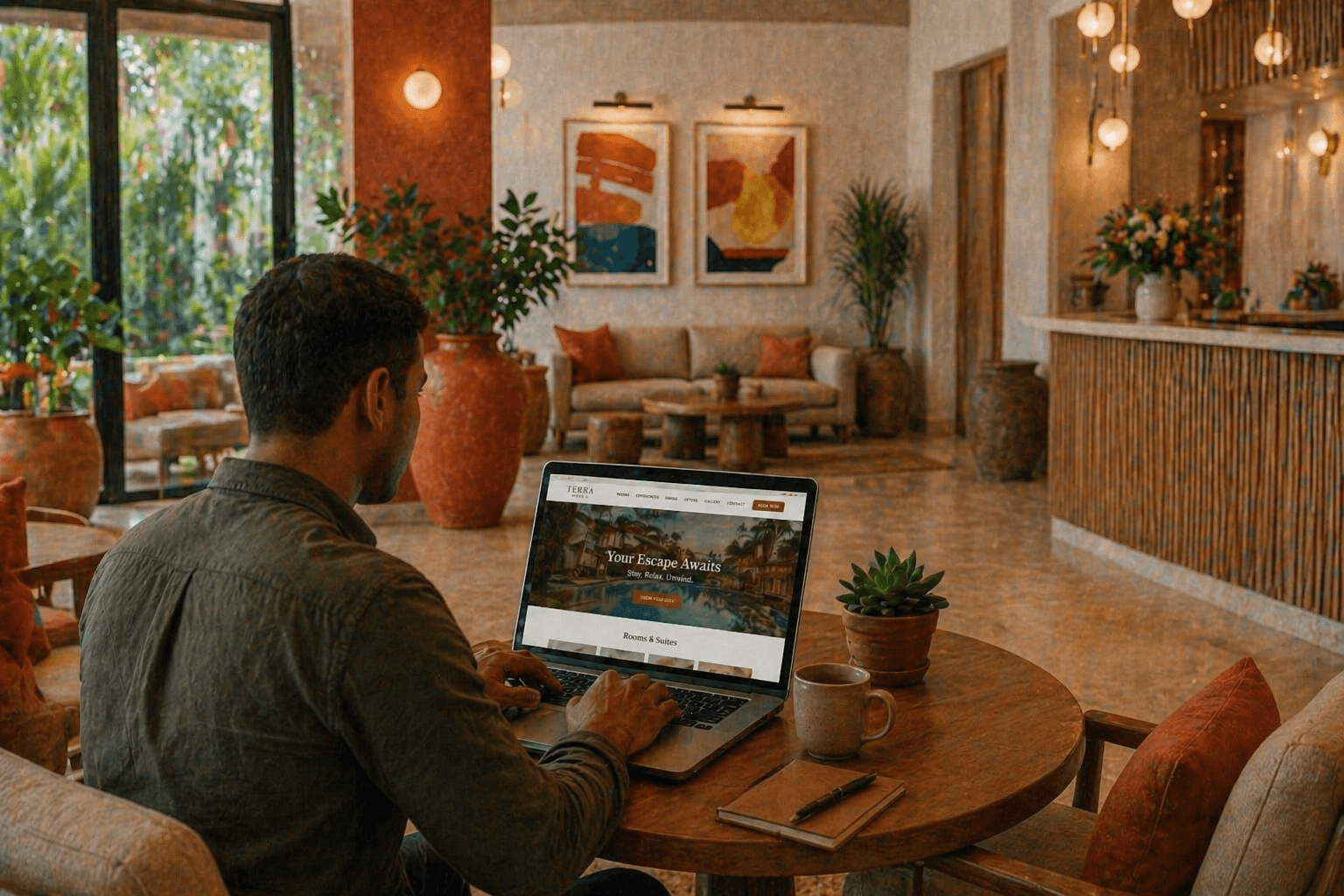
When a hotel decides to fix its hotel website, the instinct is almost always the same, to make it look better. New photos. Rewritten descriptions. Maybe a layout change. Each one is reasonable. But the mistake is picking one, expecting it to fix everything, and then wondering why bookings still are not coming in.
The real question is not which one matters. It is which one matters most at which stage of the booking journey, and how all three work together to move a visitor from curious to confirmed. Photography makes someone pause. Copy makes them stay. UX makes them work. Take any one out of the equation and the chain breaks.
Agenda
This blog answers one core question hotel owners consistently get wrong, it moves through why photography earns the first five seconds of attention, why copy does the heavy lifting during consideration and decision, and why UX is the silent killer that loses bookings at the finish line, before closing on a clear priority order for independent hotels in India looking to drive more direct bookings.
Photography: The First Five Seconds
Before a guest reads a single word on your website, they have already formed an impression. It is entirely visual, it happens in seconds, and it is very hard to reverse.
Research from the Cornell Hospitality Quarterly found that the quality of visual content on hotel websites directly influences both perceived value and willingness to pay. Guests shown premium photography were not only more likely to book but more willing to accept a higher room rate. That is the power of a strong first visual hit.
But most hotels treat photography as decoration rather than narration. They upload a photo of the room, a photo of the pool, a photo of the lobby, and call it done. What those images communicate is features, not feelings. What actually converts is photography that places the guest inside an experience. A couple on a sun-lit balcony. A quiet corner of a room at golden hour. A child at the pool while parents sit nearby with coffee. These images do not just show your property. They show guests the version of their life they want to live for the next few days.
For independent hotels in India, this matters even more because the competition is not just the hotel next door. It is every OTA listing a guest is scrolling through at the same time. If your photography does not create an immediate emotional response, you have lost that visitor before your copy even had a chance.
Photography is the highest-impact element in the awareness phase. It earns the next ten seconds of attention. But it cannot close the booking on its own.
Copy: The Element Doing the Most Work Nobody Notices
If photography makes a visitor feel something, copy is what makes them believe something. And belief is what drives the decision to book.
A hotel website suffer from what content strategists call feature-dumping, writing that lists what a room has instead of what a guest will experience. “Spacious room with king-size bed, flat-screen TV, and attached bathroom” is a feature list. It is forgettable. A copy that says “a room quiet enough to actually sleep in, with a bed you will genuinely not want to leave” activates something different. It puts the guest in the experience before they have even arrived.
A/B tests run by hotel digital marketing agency Tambourine found that rewriting room descriptions with experiential, benefit-led language, focusing on how the guest would feel rather than what the room contained, increased direct booking conversion rates measurably against the original feature-based copy. The words you use on a booking page are not just descriptive. They are persuasive.
But copy does more than sell rooms. It handles trust. When a guest is choosing between booking directly and going to an OTA, they are really asking: is this website safe, is this hotel real, and will I be taken care of if something goes wrong? Every line of copy on your site answers that question, the tone of your cancellation policy, the warmth of your FAQ, the confidence of your “Why Book Direct” section. Vague, generic copy signals an untrustworthy website. Specific, personality-driven copy signals a hotel that knows exactly who it is.
There is also the SEO dimension that photography simply cannot deliver. Copy ranks on Google. Every well-written room description, destination guide, or blog article is a discoverability asset that compounds over time. Independent hotels that invest in strong copy are building a search engine they own, something no OTA listing will ever do for them.
Copy is the highest-impact element during the consideration and decision phase. It is also the most underinvested element on most hotel websites in India.
UX: The Silent Killer at the Finish Line
Here is what happens more often than any hotel owner wants to admit. A guest finds the hotel, loves the look of it, reads the room description, feels genuinely ready to book, and then hits a booking flow that is slow, confusing, or broken on mobile. So they go back to Booking.com and finish the same transaction in ninety seconds.
UX is the infrastructure that either supports or destroys the work done by photography and copy. Baymard Institute, one of the most cited research bodies in e-commerce UX, consistently identifies checkout abandonment, people who start a purchase and leave before completing it, as one of the biggest revenue leaks in online transactions. In hotel booking, this is especially brutal because the guest was already convinced. The website just failed them at the last step.
Mobile UX is where Indian hotel website lose the most ground. Over 80% of internet users in India access the web primarily on mobile, yet a large number of hotel websites are either not mobile-optimized or are technically responsive but practically unusable on a phone, tiny tap targets, slow-loading images, booking forms that require horizontal scrolling. These are not small frustrations. They are booking killers.
The best hotel website UX is invisible. The guest never notices it because it never gets in their way. They find what they need, hit a clear CTA, complete a simple booking process, and receive a confirmation that feels professional. That seamlessness is the result of deliberate design decisions made to remove friction at every stage.
UX is the highest-impact element at the conversion phase, the final steps between intent and confirmed booking.
So Which One Matters Most?
All three, but in a sequence.
Poor photography means guests never give your copy a chance. Strong photography with weak copy creates interest without conviction. Strong photography and strong copy with broken UX builds desire and loses the booking at the finish line.
The priority order for an independent hotel building or redesigning its website is straightforward. Start with photography that tells a story, not just shows a room. Build a copy that speaks to your specific guest, answers their doubts, and gives them a reason to book directly. Then wrap both in a UX that is fast, mobile-first, and frictionless from landing page to booking confirmation.
The hotels that will win direct bookings in India over the next five years are not the ones with the biggest budgets. They are the ones that understand how guests make decisions online, and build a website that meets them at every stage of that decision with the right story, the right words, and the right path forward.
Portico WebWorks builds hotel websites designed to drive direct bookings for independent and mid-scale hotels in India. If your current hotel website is losing you bookings, let’s talk.
Read More
Turn Your Website Into a Booking Engine
Get a hotel website designed to convert visitors into direct bookings. Start with a strategy call today.