Hotel Profit Leakage: 6 Hidden Revenue Drains Costing You Lakhs Every Month

Most hotel owners track occupancy. Few track what they actually keep.

Here’s a number that should stop you: hotels that rely heavily on OTAs and run without a direct booking strategy can lose 20–35% of their potential net revenue  not to bad business, but to invisible operational gaps.

This isn’t a problem that shows up as a loss on your P&L. It shows up as tight margins. As “we’re busy, but something feels off.” As growth that never quite arrives.

After working with hotel operators across different segments, we’ve identified six specific places where this profit quietly disappears  and what high-performing hotels do differently.

Agenda

This article breaks down where hotel revenue quietly slips through the cracks, even when occupancy looks strong. It outlines six common profit leaks, from OTA dependency and website drop-offs to pricing gaps and operational inefficiencies, and explains how each one impacts your bottom line. More importantly, it highlights the practical steps high-performing hotels take to identify these gaps, improve visibility across teams, and convert more of their revenue into actual profit.

1. OTA Dependency – The Biggest Silent Drain

Online Travel Agencies deliver bookings. But every booking they bring costs you money.

Typical OTA commission rates:

OTA PlatformCommission Range
Booking.com15% – 25%
Expedia15% – 22%
MakeMyTrip12% – 18%
Agoda15% – 20%

On a ₹5,000 room booking, you’re handing over ₹750 to ₹1,500, instantly, before a single rupee goes toward your costs.

Scale that to 200 bookings a month at 20% commission and you’re surrendering ₹2 lakh or more every single month.

The deeper problem: most hotels optimize for occupancy, not net revenue. A hotel at 85% occupancy on OTAs may be less profitable than a competitor at 70% with strong direct bookings.

2. Website Drop-Off – Demand You’re Not Capturing

Here’s a pattern that repeats across hotel websites:

Typical booking funnel behaviour:

  • 100 visitors land on your website
  • 40 browse room options
  • 15 click “Book Now”
  • 4–6 actually complete the booking

The other 9–11 people who clicked “Book Now”? Most of them go back to an OTA and book the same room, often paying more, while you earn less.

Common reasons guests abandon your booking page:

  • Page loads slowly on mobile
  • The booking engine asks for too many steps
  • There’s no clear reason to book direct (no price guarantee, no benefit)
  • The site looks dated or untrustworthy

You paid to get them to your site. Poor UX hands them back to Booking.com.

3. Rate Leakage –

 Selling the Same Room at Three Different Prices

Check your own hotel right now. Search for it on two OTAs and your website.

It’s common to find something like this:

ChannelRoom Rate
Booking.com₹7,800
Agoda₹7,600
Your Website₹6,900

This creates two problems. First, you’re earning less per booking on your direct channel than the one with zero commission. Second, OTAs penalise rate parity violations, and guests who see the inconsistency lose trust in your brand.

Every booking at ₹6,900 instead of ₹7,800 is ₹900 of margin lost  not from a discount you chose to offer, but from a gap in rate management.

4. Operational Leakages – Money Lost Inside the Building

This is the category that surprises most hotel owners because it happens across dozens of small transactions every day.

Common unbilled or misapplied charges: 

  • Late checkout fees waived without authorisation
  • Cancellation charges not applied when policy allows
  • OTA payment mismatches (you’re owed ₹4,800, you received ₹4,600  and no one followed up)
  • Room upgrades given without upsell pricing

Individually, each of these is small. Across 3,000 checkouts a year, even ₹150 per missed charge adds up to ₹4.5 lakh annually  money that was earned but never collected.

5. High Occupancy, Low Profit – The Illusion of a Full Hotel

This is the most emotionally difficult pattern to diagnose, because everything looks fine from the outside.

Your hotel is full. The team is busy. Guests are checking in and out.

But the P&L tells a different story.

Why does this happen?

  • High OTA mix (80%+ of bookings through third parties)
  • Rooms sold at discounted rates to maintain occupancy
  • No upselling F&B, spa, early check-in, transfers
  • High variable costs eating into a thinning margin

Occupancy is a vanity metric if RevPAR (Revenue Per Available Room) and GOPPAR (Gross Operating Profit Per Available Room) are weak. A hotel running at 65% occupancy with strong direct bookings and active upselling routinely outperforms a “full” hotel with heavy OTA dependency.

6. Disconnected Teams  The Structural Leak Nobody Talks About

Marketing brings traffic. Revenue management sets pricing. Finance tracks outcomes.

In most hotels, these three functions operate in silos. Marketing doesn’t know which channels are most profitable. Revenue management doesn’t get feedback from Finance fast enough to adjust pricing. Finance gets monthly reports instead of weekly signals.

The result:

  • Promotions run on already-profitable dates, eroding margin unnecessarily
  • Pricing doesn’t respond to demand signals quickly enough
  • Nobody owns the question: “Which booking was actually worth taking?”

This isn’t a people problem. It’s a systems and visibility problem.

What Smart Hotels Do Differently

Hotels that consistently grow net profit  not just revenue  focus on five things:

1. Direct booking strategy with a reason to book direct Price match guarantee, free early check-in, complimentary transfer, loyalty points. Give guests a clear, specific reason to skip the OTA.

2. Website conversion optimization Fast load times. A mobile-first booking engine. Three steps or fewer from “Book Now” to confirmed reservation.

3. Channel-wise profitability tracking Not just which channel sends bookings  but which channel sends profitable bookings. OTA bookings look great in occupancy reports. They look different in a net revenue analysis.

4. Regular revenue audits Monthly review of missed charges, rate inconsistencies, and OTA reconciliation. Assign ownership. Make it a process, not a one-time fix.

5. Cross-functional revenue meetings Marketing, Revenue, and Finance in the same room (or call), weekly. Align on what’s working, what’s leaking, and what to change next week  not next quarter.

The Real Question Isn’t “How Much Are We Earning?”

It’s: how much are we actually keeping?

A hotel earning ₹1.2 crore a month with 28% OTA dependency and operational gaps may be netting less than a competitor earning ₹90 lakh with strong direct channels and tight operational controls.

Profit leakage is fixable. But you can’t fix what you can’t see.

If your hotel is running full but margins feel thin, the starting point is a revenue audit, a structured look at where money is entering, where it’s exiting, and what’s falling through the gaps in between.

Interested in identifying where your hotel is losing revenue? We conduct focused revenue audits for independent hotels and small chains. Book a 30-minute discovery call →

Read More

The Role of Trust Signals in Hotel Bookings

Before you fix conversion, fix trust, here’s how the right signals on your booking flow can dramatically reduce drop-offs and increase direct bookings.

Photography, Copy, or UX, What Actually Converts Visitors on a Hotel Website?

hotel website

When a hotel decides to fix its hotel website, the instinct is almost always the same, to make it look better. New photos. Rewritten descriptions. Maybe a layout change. Each one is reasonable. But the mistake is picking one, expecting it to fix everything, and then wondering why bookings still are not coming in.

The real question is not which one matters. It is which one matters most at which stage of the booking journey, and how all three work together to move a visitor from curious to confirmed. Photography makes someone pause. Copy makes them stay. UX makes them work. Take any one out of the equation and the chain breaks.

Agenda

This blog answers one core question hotel owners consistently get wrong, it moves through why photography earns the first five seconds of attention, why copy does the heavy lifting during consideration and decision, and why UX is the silent killer that loses bookings at the finish line, before closing on a clear priority order for independent hotels in India looking to drive more direct bookings.

Photography: The First Five Seconds

Before a guest reads a single word on your website, they have already formed an impression. It is entirely visual, it happens in seconds, and it is very hard to reverse.

Research from the Cornell Hospitality Quarterly found that the quality of visual content on hotel websites directly influences both perceived value and willingness to pay. Guests shown premium photography were not only more likely to book but more willing to accept a higher room rate. That is the power of a strong first visual hit.

But most hotels treat photography as decoration rather than narration. They upload a photo of the room, a photo of the pool, a photo of the lobby, and call it done. What those images communicate is features, not feelings. What actually converts is photography that places the guest inside an experience. A couple on a sun-lit balcony. A quiet corner of a room at golden hour. A child at the pool while parents sit nearby with coffee. These images do not just show your property. They show guests the version of their life they want to live for the next few days.

For independent hotels in India, this matters even more because the competition is not just the hotel next door. It is every OTA listing a guest is scrolling through at the same time. If your photography does not create an immediate emotional response, you have lost that visitor before your copy even had a chance.

Photography is the highest-impact element in the awareness phase. It earns the next ten seconds of attention. But it cannot close the booking on its own.

Copy: The Element Doing the Most Work Nobody Notices

If photography makes a visitor feel something, copy is what makes them believe something. And belief is what drives the decision to book.

A hotel website suffer from what content strategists call feature-dumping, writing that lists what a room has instead of what a guest will experience. “Spacious room with king-size bed, flat-screen TV, and attached bathroom” is a feature list. It is forgettable. A copy that says “a room quiet enough to actually sleep in, with a bed you will genuinely not want to leave” activates something different. It puts the guest in the experience before they have even arrived.

A/B tests run by hotel digital marketing agency Tambourine found that rewriting room descriptions with experiential, benefit-led language, focusing on how the guest would feel rather than what the room contained, increased direct booking conversion rates measurably against the original feature-based copy. The words you use on a booking page are not just descriptive. They are persuasive.

But copy does more than sell rooms. It handles trust. When a guest is choosing between booking directly and going to an OTA, they are really asking: is this website safe, is this hotel real, and will I be taken care of if something goes wrong? Every line of copy on your site answers that question, the tone of your cancellation policy, the warmth of your FAQ, the confidence of your “Why Book Direct” section. Vague, generic copy signals an untrustworthy website. Specific, personality-driven copy signals a hotel that knows exactly who it is.

There is also the SEO dimension that photography simply cannot deliver. Copy ranks on Google. Every well-written room description, destination guide, or blog article is a discoverability asset that compounds over time. Independent hotels that invest in strong copy are building a search engine they own, something no OTA listing will ever do for them.

Copy is the highest-impact element during the consideration and decision phase. It is also the most underinvested element on most hotel websites in India.

UX: The Silent Killer at the Finish Line

Here is what happens more often than any hotel owner wants to admit. A guest finds the hotel, loves the look of it, reads the room description, feels genuinely ready to book, and then hits a booking flow that is slow, confusing, or broken on mobile. So they go back to Booking.com and finish the same transaction in ninety seconds.

UX is the infrastructure that either supports or destroys the work done by photography and copy. Baymard Institute, one of the most cited research bodies in e-commerce UX, consistently identifies checkout abandonment, people who start a purchase and leave before completing it, as one of the biggest revenue leaks in online transactions. In hotel booking, this is especially brutal because the guest was already convinced. The website just failed them at the last step.

Mobile UX is where Indian hotel website lose the most ground. Over 80% of internet users in India access the web primarily on mobile, yet a large number of hotel websites are either not mobile-optimized or are technically responsive but practically unusable on a phone, tiny tap targets, slow-loading images, booking forms that require horizontal scrolling. These are not small frustrations. They are booking killers.

The best hotel website UX is invisible. The guest never notices it because it never gets in their way. They find what they need, hit a clear CTA, complete a simple booking process, and receive a confirmation that feels professional. That seamlessness is the result of deliberate design decisions made to remove friction at every stage.

UX is the highest-impact element at the conversion phase, the final steps between intent and confirmed booking.

So Which One Matters Most?

All three, but in a sequence.

Poor photography means guests never give your copy a chance. Strong photography with weak copy creates interest without conviction. Strong photography and strong copy with broken UX builds desire and loses the booking at the finish line.

The priority order for an independent hotel building or redesigning its website is straightforward. Start with photography that tells a story, not just shows a room. Build a copy that speaks to your specific guest, answers their doubts, and gives them a reason to book directly. Then wrap both in a UX that is fast, mobile-first, and frictionless from landing page to booking confirmation.

The hotels that will win direct bookings in India over the next five years are not the ones with the biggest budgets. They are the ones that understand how guests make decisions online, and build a website that meets them at every stage of that decision with the right story, the right words, and the right path forward.

Portico WebWorks builds hotel websites designed to drive direct bookings for independent and mid-scale hotels in India. If your current hotel website is losing you bookings, let’s talk.

Read More

Turn Your Website Into a Booking Engine
Get a hotel website designed to convert visitors into direct bookings. Start with a strategy call today.

The Role of Trust Signals in Hotel Bookings

Trust signals in hotel bookings

When a guest lands on your hotel website, they are not just browsing rooms. They are making a decision that involves money, safety, comfort, and expectations. Unlike buying a product, a hotel stay is an experience they cannot “test” before booking. This is where Trust signals in hotel bookings become critical.

Trust signals in hotel bookings are the elements on your website that reassure visitors that your hotel is reliable, safe, and worth their money. In today’s digital-first travel landscape, where platforms like Booking.com and Tripadvisor dominate decision-making, your website must work just as hard to build credibility.

Agenda

In today’s digital-first travel journey, trust is the deciding factor between a visitor and a confirmed booking. This article explores how trust signals, such as authentic guest reviews, transparent pricing, secure payment systems, and real visuals, play a critical role in reducing uncertainty and influencing booking decisions. It also examines how these elements align with EEAT principles to improve both user confidence and search engine visibility. By understanding and implementing the right trust signals in hotel bookings, hotels can increase direct bookings, minimise reliance on third-party platforms, and build long-term guest loyalty.

What Are Trust Signals in the Hospitality Industry?

Trust signals are visual, textual, and structural elements that reduce uncertainty and build confidence. These include guest reviews, certifications, secure payment icons, real photos, clear policies, and brand consistency.

From an EEAT perspective (Experience, Expertise, Authoritativeness, Trustworthiness), trust signals directly influence how credible your hotel appears to both users and search engines like Google.

Why Trust Signals Matter More Than Ever

Travel decisions today are research-heavy. Guests compare multiple properties, read reviews, check photos, and evaluate risks before booking. If your website lacks trust indicators, users quickly drop off and return to OTAs.

A well-optimised hotel website with strong trust signals can:

  • Increase direct bookings
  • Reduce dependency on third-party platforms
  • Improve conversion rates
  • Build long-term brand loyalty

Key Trust Signals That Drive Hotel Bookings

1. Authentic Guest Reviews and Testimonials

Guest reviews are one of the strongest trust builders. Real experiences reduce uncertainty and create social proof.

Embedding reviews from platforms like Tripadvisor or Google Reviews directly on your website shows transparency. Highlight both positive feedback and how you respond to criticism.

What works best:

  • Verified guest reviews
  • Recent testimonials
  • Responses from hotel management

This signals that your hotel values guest experience and accountability.

2. High-Quality, Real Images and Videos

Stock images damage trust. Guests want to see exactly what they will get.

Include:

  • Real room photos
  • Bathroom and amenities
  • Lobby and common areas
  • Dining spaces

Consistency between your website and OTA listings is crucial. Mismatched visuals create doubt and increase bounce rates.

3. Clear Pricing and Transparent Policies

Hidden charges are one of the fastest ways to lose a booking.

Make sure your website clearly displays:

  • Taxes and additional fees
  • Cancellation policies
  • Check-in and check-out timings

Transparency reduces friction and increases confidence during checkout.

4. Secure Payment Badges and SSL Certificates

When users reach the payment stage, security becomes their top concern.

Display:

  • SSL certificate (HTTPS)
  • Recognisable payment icons (Visa, Mastercard, UPI)
  • Secure booking messaging

These small visual cues reassure users that their financial data is safe.

5. Awards, Certifications, and Affiliations

Recognition from credible organisations adds authority.

Examples include:

  • Tourism board certifications
  • Star ratings
  • Industry awards

Even partnerships or listings on platforms like MakeMyTrip or Airbnb can reinforce credibility.

6. Strong “About Us” and Brand Story

Guests don’t just book rooms, they connect with stories.

An effective “About Us” page should include:

  • Hotel history
  • Founder or management story
  • Commitment to service

Adding real team photos or a short welcome message builds emotional trust and human connection.

7. Consistent Contact Information and Accessibility

A trustworthy hotel is easy to reach.

Ensure:

  • Phone number is visible
  • Email is professional
  • Google Maps integration is accurate

Adding a physical address and directions reassures users that your hotel is legitimate.

8. Real-Time Availability and Booking Confirmation

Instant confirmation builds reliability.

A smooth booking engine that shows:

  • Live availability
  • Instant confirmation emails
  • Booking summaries

Common Mistakes Hotels Make

Many hotel websites fail not because of design, but because of missing trust elements.

Avoid:

  • Using only stock images
  • Hiding policies or pricing
  • No visible reviews
  • Outdated content
  • Broken booking systems

Even a visually appealing website cannot convert without trust.

How Trust Signals Impact Direct Bookings?

When trust signals in hotel bookings is established, users feel confident booking directly instead of going back to OTAs. This reduces commission costs and increases profit margins.

Hotels that invest in trust-building often see:

  • Higher direct conversion rates
  • Repeat bookings
  • Stronger brand recall

Final Thoughts

Trust signals in hotel bookings is not built through one element, it is the result of multiple signals working together. From reviews and visuals to security and transparency, every detail contributes to the guest’s decision.

In a competitive hospitality market, your website must do more than look good. It must reassure, validate, and convert.

If your hotel website can answer one simple question, “Can I trust this place?”, you are already ahead of most competitors.

Read More

Turn Your Website Into a Booking Engine
Get a hotel website designed to convert visitors into direct bookings. Start with a strategy call today.

9 Questions Every Hotel Owner Should Ask Before Hiring Hotel Marketing Agency

hotel marketing agency

Running a hotel today is not just about great rooms and good service. It is also about visibility, positioning, and consistent demand. Whether it is digital marketing, revenue management, branding, or OTA optimisation, many hotel owners now depend on external agencies to handle growth.

But here is the real issue: not every agency understands hospitality.

Hiring the wrong hotel marketing agency does not just waste money, it directly impacts bookings, guest perception, and long-term brand value. That is why asking the right questions before signing any contract is critical.

This guide will walk you through the most important questions every hotel owner should ask before hiring an agency, so you make a decision that actually drives results.

Agenda

Before you hire a marketing agency for your hotel, it is important to have a clear framework in mind. This agenda outlines the key areas you need to evaluate, from industry experience and proven results to pricing strategy, communication, and long-term alignment. By following this structure, you can make a more informed decision and choose an agency that truly supports your hotel’s growth.

1. Do You Have Experience in the Hospitality Industry?

This is the first and most important filter.

Marketing a hotel is very different from marketing a product or a regular business. Hotels deal with fluctuating demand, seasonal pricing, OTA dependencies, guest reviews, and last-minute bookings.

Hotel marketing agency that has worked with hotels will understand:

  • Occupancy cycles
  • Average Daily Rate (ADR) strategies
  • Booking windows
  • Guest behaviour patterns

If they cannot show real hotel case studies, you are taking a risk.

2. What Results Have You Delivered for Similar Hotels?

Do not settle for generic answers.

Ask for:

  • Before-and-after performance data
  • Increase in direct bookings
  • Improvement in RevPAR (Revenue Per Available Room)
  • Reduction in OTA dependency

A good hotel marketing agency will have clear numbers and not just creative portfolios

3. How Will You Increase Direct Bookings?

This is where many agencies fail.

Most hotels already get bookings from OTAs, but the real profitability comes from direct bookings through your website.

Ask how they plan to:

  • Improve your website conversion rate
  • Run targeted campaigns
  • Build brand trust
  • Retarget past visitors

If their strategy only focuses on “more traffic,” it is incomplete. Traffic without conversion is wasted spend.

4. How Do You Approach OTA Strategy?

OTAs are important, but over-dependence is dangerous.

A smart agency should help you:

  • Optimise listings (images, descriptions, pricing)
  • Manage reviews effectively
  • Balance OTA and direct booking channels
  • Avoid unnecessary commission loss

If hotel marketing agency ignore OTA strategy, they do not fully understand hotel revenue dynamics.

5. What Is Your Approach to Pricing and Revenue Management?

Marketing alone cannot fix poor pricing.

Ask if the agency understands:

  • Dynamic pricing
  • Competitor benchmarking
  • Demand forecasting
  • Seasonal adjustments

The best agencies combine marketing with revenue intelligence to maximise profitability, not just visibility.


6. How Will You Track and Report Performance?

Transparency is non-negotiable.

You should know exactly where your money is going and what results you are getting.

Ask:

  • What metrics will be tracked?
  • How often will reports be shared?
  • Will you have access to dashboards?

Key metrics should include:

  • Website conversions
  • Cost per booking
  • ROI on campaigns
  • Occupancy growth

Avoid hotel marketing agency that rely on vague reporting.

7. Who Will Actually Work on My Account?

Many agencies sell with senior teams but assign junior staff later.

Clarify:

  • Who will manage your account daily
  • Their experience level
  • Availability for communication

Consistency matters because your hotel’s growth depends on execution, not just strategy.

8. What Is Your Communication and Response Time?

Hotels operate 24/7. Your agency should not behave like a 9–5 vendor.

Ask about:

  • Response time for urgent issues
  • Weekly or monthly check-ins
  • Support during high-demand periods

Slow communication can cost you bookings, especially during peak seasons.

9. How Do You Handle Online Reputation Management?

Guest reviews can make or break your hotel.

A strong agency should:

  • Monitor reviews across platforms
  • Respond professionally and quickly
  • Highlight positive guest experiences
  • Manage negative feedback strategically

Ignoring reputation management is a major mistake in hospitality marketing.

10. What Is the Contract Structure and Exit Policy?

Always read the fine print.

Ask:

  • Is there a lock-in period?
  • What happens if performance is not satisfactory?
  • Can you exit without heavy penalties?

A confident hotel marketing agency will not trap you in long-term contracts without flexibility.

11. How Will You Align With My Brand Positioning?

Every hotel is different.

A luxury resort, a boutique hotel, and a budget property cannot have the same marketing approach.

Ensure the agency understands:

  • Your target audience
  • Your pricing segment
  • Your unique selling points

Generic marketing leads to average results.

12. What Tools and Technology Do You Use

Modern hotel marketing relies heavily on tools.

Ask about:

  • Booking engine integrations
  • Analytics platforms
  • CRM systems
  • Ad tracking tools

The right technology stack improves both efficiency and accuracy.

Final Thoughts

Hiring hotel marketing agency is not just a business decision, it is a growth decision.

The right agency can:

  • Increase your bookings
  • Improve your profitability
  • Strengthen your brand

The wrong one can do the opposite.

Take your time, ask the right questions, and do not rush into partnerships based on promises alone. In hospitality, results matter more than words.

Want to understand why OTAs outperform your website in converting guests? Read: https://porticowebworks.com/blog/strategy/what-ota-know-about-your-guests-that-your-website-does-not

What OTA know about your guests that your website does not

OTA

Introduction

In the hospitality industry Online Travel Agencies like Booking.com and Expedia are really powerful. They help hotels get seen by people get more bookings and reach people all around the world. For hotels Online Travel Agencies are a big part of how they sell rooms.. There is something that many hotels are just starting to understand. Online Travel Agencies often know more about your guests than your own website does.

Agenda

This topic begins by explaining the growing importance of Online Travel Agencies (OTAs) in the hospitality industry and how they have become powerful platforms for driving bookings and visibility. It then focuses on the key advantage OTAs have data. By tracking user behavior such as search patterns, preferences, and booking habits, OTAs are able to understand guests deeply and influence their decisions through personalized recommendations and smart tactics. In contrast, hotel websites are discussed as being limited in the kind of data they collect, mostly capturing information only at the booking stage, which leaves a major gap in understanding guest intent and behavior before the purchase.

How OTAs collect guest data

When people search for hotels on an Online Travel Agency they leave behind a lot of information. It is not about what they book. Online Travel Agencies track what places people search for how often they travel, what kind of hotels they look at how long they compare options and even what makes them decide not to book a hotel. Over time this information helps Online Travel Agencies create detailed profiles of their guests.

What OTAs know about your guests

Online Travel Agencies know if someone likes hotels or cheaper ones. They can tell if someone usually books a hotel at the minute or plans ahead. They know if someone travels alone with a friend or with their family. They even know what kind of places people like to stay in. Like near the beach in the city or in an area. This helps Online Travel Agencies give people personalized suggestions that feel like they really understand what the person is looking for.

What hotel websites actually know

Now lets compare this to hotel websites.

Most of the time hotel websites only get information from people when they are already booking a room. This usually includes things like their name, email address what dates they are staying and how they are paying. While this information is important it does not tell hotels much about what their guestsre thinking or what they want.

The missing data before booking

What hotels are missing is everything that happens before someone books a room. Hotels often do not know what hotels someone looked at what kind of room they wanted, how much it cost or why they chose one hotel over another. This means hotels do not know how to make their website and marketing better.

Why OTAs win the booking game

This is where Online Travel Agencies do a job.

Because Online Travel Agencies understand their users well they can show people the right hotel at the right time. They can say things like “ one room left” to make people want to book faster. They can offer deals or suggest other hotels that are similar to what the person is looking for. All of this makes it more likely that someone will book a hotel.

Not a problem, but a missed opportunity

For hotels this is not a problem with how they do things. It is a missed chance to get more bookings.

Direct bookings are about relationships

When people book a hotel directly it is not about saving money on commissions. It is about hotels having a relationship with their guests. To have a relationship hotels need to think about more than just getting bookings. They need to think about understanding their guests.

What hotels can do differently

So what can hotels do?

1. Improve your website tracking

First hotels need to make their website better. A good website should not just take bookings. Also track what people do on the website. Like what they search for what pages they look at and where they stop looking.

2. Use data to make better decisions

Second hotels need to use the information they get from their website better. Even simple things like looking at what page are most popular can help. For example are people looking for rooms for the weekend? Are people looking at types of rooms but not booking them? This information can help hotels decide how to price their rooms what specials to offer and how to design their website.

3. Personalize the website experience

Third hotels need to make their website more personal. Even small things. Like showing people deals highlighting popular rooms or remembering when someone comes back to the website. Can make a big difference.

4. Think long term, Not just bookings

Finally hotels need to think about the term. Every time someone books a hotel directly it is not about getting money. It is about getting information and understanding the guest better for next time.

Conclusion: Understanding guests is the real advantage

At the end of the day Online Travel Agencies are successful because they understand people who travel well. Hotels do not need to be as big, as Online Travel Agencies. They do need to start understanding their guests better.

Because getting the booking is important. But really understanding your guest is what makes them come back tells their friends about the hotel. Helps the hotel grow in the long term.

What hotel websites taught me about above-the-fold

What hotel websites taught me about above-the-fold

Why this one section quietly decides trust, scroll, and direct bookings

Summary: Above-the-fold plays a decisive role in hotel websites because most users arrive with low trust and high intent. Unlike well-known brands, smaller hotels must quickly establish credibility through clear visuals, a strong headline, and immediate booking cues. This section acts as a quick evaluation zone where users check relevance, pricing, availability, and overall vibe before deciding to scroll. Poor hierarchy, missing context, or too many choices create confusion and increase bounce rates. Elements like ratings, location clarity, and authentic imagery help build instant confidence. When designed well, above-the-fold earns the scroll and gives the rest of the website a chance to convert.

Research context

As part of my research on improving direct bookings for hotels, I have been studying numerous hotel websites closely.

Before joining Portico Webworks, I worked on user experience for mobile applications. In mobile apps, I never really felt the need to optimize the above-the-fold. Users download an app with intent. They are already committed and willing to explore.

Before this phase of my work, I had never consciously observed hotel websites from a UX point of view. That changed when I started designing a hotel website for a brand. To design better, I began studying how different hotels handle their above-the-fold.

To understand patterns, I randomly looked at more than 30 hotel websites.

Some of them made me pause. I remember thinking, wow, this is a very well known and popular hotel brand, but why does the website feel like this. I even questioned whether people book hotels even if the website experience is not great, simply because the brand is famous.

Then the realization hit me.

Popular hotel brands can afford weak or broken website experiences because trust already exists outside the website. But that luxury does not apply to hotels that are not well known. For them, the website has to work harder. It has to build trust quickly.

First impressions on above-the-fold

When I land on a hotel website, my eyes almost always go straight to the centre of the above-the-fold. If the visual is strong and there is a heading that catches my attention, I instinctively feel like scrolling to check whether this hotel is actually good. This could be a still image, an animation, a video, or a simple image slider.

In hospitality, if the vibe through visuals and the utility through location clarity, pricing cues, or a visible booking bar are not immediate, bounce rates spike.

Another behavior I consistently noticed is how users treat the above-the-fold as a quick check zone. Sometimes I am not ready to book. I just want to see if rooms are available on my desired dates or get a sense of pricing. If that utility is hidden or requires extra clicks, it feels like unnecessary effort.

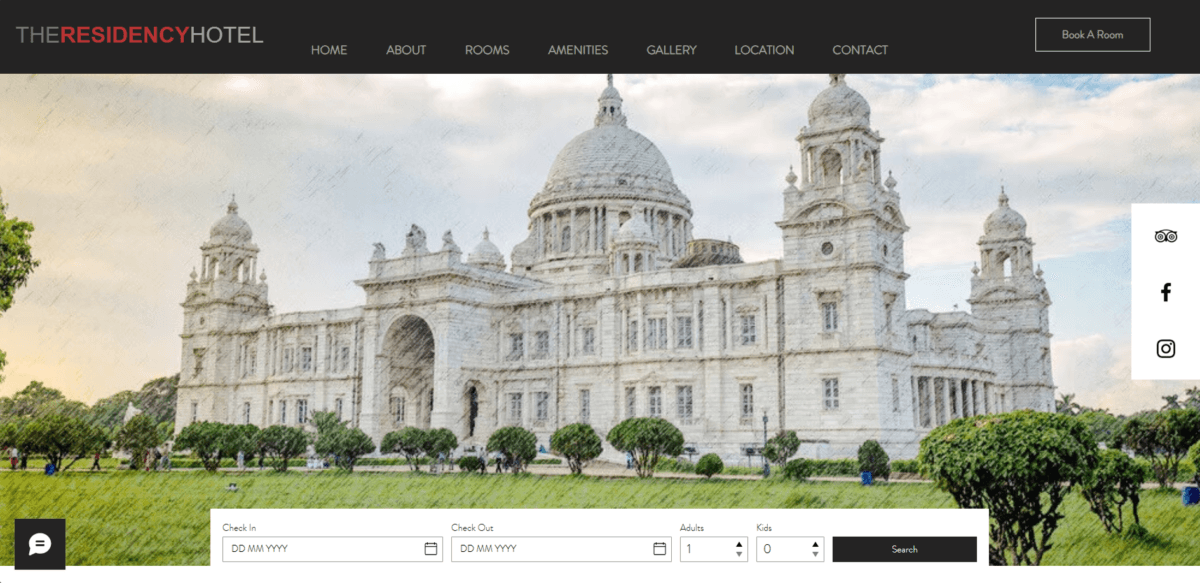
While analysing websites, I came across one homepage that clearly showed how things can go wrong above-the-fold.

Case study: what went wrong

Missing headline

When I landed on the page, the first thing I noticed was that the headline was missing entirely. There was no clear message telling me what kind of hotel this is or where it is located. As a visitor, I genuinely did not know whether this was a heritage stay, a business hotel, or a city reso

Confusing visuals

The visual made the confusion worse. The hero image showed a famous monument instead of the hotel itself. It sold the destination, not the stay. I could not imagine the rooms, the atmosphere, or what it would feel like to actually stay there.

Overloaded interface

Then came the interface. Navigation links, social media icons, a floating chat button, and a large booking bar were all present at the same time. Everything competed for attention. Nothing clearly guided my eyes toward the next step. There was no visual hierarchy.

This is where basic UX principles become very real. Miller’s Law tells us that the human brain can handle only around seven items at a time. When too many elements appear above-the-fold, users feel overwhelmed without knowing exactly why.

Lack of trust and clarity

I also noticed that there was no trust or reassurance built into the context. No visible location cue. No rating. No supporting line to orient the guest. The website asked me to interact before helping me feel confident.

This pattern showed up across several sites.

The power of ratings, location, and social proof

Ratings also play a huge role. When ratings are visible above-the-fold, there is an instant reaction. This place must be nice. Let me look more. Even a good looking website feels incomplete when social proof is missing.

In some websites, I had moments where I genuinely questioned whether the image shown was even the hotel. That alone break trust.

Location clarity is another small but powerful detail. If the exact location is visible upfront, I can quickly check distances on Google without wasting time trying to find where the hotel actually is.

Decision making and button overload

I also noticed how decision making slows down when too many actions are presented. Multiple buttons like book now, check availability, and view rooms compete with each other. Hick Hyman Law explains this clearly. The more choices we give users, the longer it takes for them to decide.

My own behavior is simple. I usually discover hotels on booking platforms first. Then I visit the hotel website to check whether it feels trustworthy and worth booking directly. If the above-the-fold gives me confidence, I scroll further. If it does not, I leave.

Key takeaways: designing above-the-fold

This is why above-the-fold should be simple, professional, and intentional. A clear heading. Visuals that represent the actual property. Limited navigation. One clear primary action. Balanced use of brand colors that do not overpower the experience.

The fold does not stop the scroll. It earns the scroll.

In most cases, users decide whether to trust a hotel within the first few seconds. When above-the-fold builds clarity and confidence, the rest of the website finally gets the chance to do its job.

How to Tell Whether Your Hotel Website Is Actually Helping, or Just Existing?

hotel website

During a recent website audit, a hotel owner asked us a direct question:

“Is my website actually working?”

It’s a simple question, but one most hotels never properly answer.

Because a website can look polished, load fine on desktop, and still quietly fail at its primary job: driving direct bookings.

At Portico Webworks, we evaluate hotel websites not by how they look, but by how they perform. And the difference between a website that exists and one that works is measurable.

TL;DR: If Your Website Isn’t Driving Bookings, It’s Not Working

Most hotel websites are mistaken for digital brochures when they should be functioning as revenue-generating tools. The simplest way to assess performance is by looking at your last three months of booking data and calculating what percentage comes directly from your website.

If that number is below 20%, your website is not contributing meaningfully to your business, it’s simply supporting OTA platforms that ultimately take commission on bookings you could have owned.

A high-performing hotel website is fast, mobile-optimized, easy to navigate, and built to guide a guest from interest to booking without friction. If guests are discovering your property on Google but completing their booking elsewhere, the issue is not visibility, it’s conversion.

The One Metric That Tells You Everything

If you want a clear answer, start here:

Take your last 3 months of booking data
Separate direct website bookings from OTA bookings

Now calculate:

Direct Booking Percentage = (Direct Bookings ÷ Total Bookings) × 100

What the number actually means:

  • Above 40% → Strong direct channel (your website is performing well)
  • 20%–40% → Average (room for optimization)
  • Below 20% → Your website is not a sales tool, it’s a brochure

If your direct bookings are under 20%, your website is not contributing meaningfully to revenue. It’s simply supporting OTAs.

Why Most Hotel Websites Underperform

From our audits at Portico Webworks, most hotel websites fail for the same structural reasons:

1. Built for Appearance, Not Conversion

Hotels often invest in visual design, full-screen sliders, high-resolution galleries, animations, but overlook the booking journey.

A guest doesn’t come to admire your website.
They come to decide quickly.

2. No Clear Path to Booking

If a guest has to search for your booking button, scroll excessively, or click multiple times to see prices, friction increases.

And friction kills intent.

3. Slow Load Times on Mobile

Most guests visit your website on a phone, often on average 4G.

If your website takes more than 3 seconds to load, a large portion of visitors leave before seeing anything meaningful.

4. Weak or Missing Trust Signals

Guests need reassurance before they book:

  • Reviews
  • Cancellation policies
  • Secure payment indicators
  • Clear pricing

If these aren’t visible immediately, doubt replaces intent.

5. OTA Comparison Happens in Real Time

Your website is not viewed in isolation.

Guests typically have multiple tabs open, including OTA listings.

If your site is slower, less clear, or harder to use, the decision is instant:

They book where it’s easier.

The Real Purpose of a Hotel Website

There’s a common misconception:

“Our website is there to give information.”

That’s incomplete.

The actual purpose is:

To convert interest into a booking, quickly and confidently.

Every element on your website should support that outcome:

  • Can a guest understand your property in 5 seconds?
  • Can they see rooms and pricing without effort?
  • Can they book without hesitation?

If not, the website is underperforming — regardless of how it looks.

A Simple Self-Audit You Can Do Today

You don’t need technical expertise to identify major issues.

Open your website on your phone (using mobile data, not Wi-Fi) and go through this:

  1. Time the load speed
    → Does it load within 3 seconds?
  2. Find a room and its price
    → How many taps did it take?
  3. Try to book
    → Is the process smooth or confusing?
  4. Look for trust signals
    → Are reviews, policies, and guarantees visible?
  5. Ask yourself honestly:
    → Would you book here — or switch to an OTA?

This exercise alone reveals most conversion problems.

What High-Performing Hotel Websites Do Differently

At Portico Webworks, we consistently see that high-converting websites share a few traits:

  • Fast load times (especially on mobile)
  • Clear “Book Now” visibility at all times
  • Immediate value proposition (why book direct?)
  • Transparent pricing and room details
  • Strong trust signals placed early
  • Minimal friction from landing to checkout

They are not necessarily more beautiful they are simply easier to book from.

The Cost of Getting This Wrong

When your website underperforms, the impact is not neutral.

It leads to:

  • Increased OTA dependency
  • Higher commission payouts
  • Loss of direct customer relationships
  • Reduced control over pricing and guest experience

In practical terms, you are paying platforms to bring back guests who already found you.

Final Thought: Measure What Matters

A hotel website is not a branding exercise.
It’s a revenue channel.

If you’re not measuring:

  • Direct booking percentage
  • Booking abandonment
  • Mobile performance

…you’re operating without visibility into a critical part of your business.

The Bottom Line

If your direct bookings are below 20%, your website isn’t broken but it isn’t doing its job either.

And until that changes, your growth will remain tied to platforms you don’t control.

Read More –

Want to know how to turn your hotel website visitors into paying guests? Discover How Do Guests Book Hotels Today.

How to Write a Room Description That Gets More Hotel Bookings

Room Description

When hotels think about room descriptions, many focus on sounding polished. They want the copy to feel warm, premium, and inviting. That part matters. But in real booking behaviour, clarity matters more.

After reviewing many hotel and resort websites, one issue comes up again and again: room descriptions often stop just before the information a guest actually needs to make a decision.

The copy may sound elegant, but it leaves out the basics. Guests are told a room is “spacious” without being told the size. They read “perfect for families” without knowing the maximum occupancy. They see “luxurious bedding” without knowing whether the room has one king bed, two twins, or something else entirely.

This is where many room descriptions fail. They create interest, but they do not remove doubt.

A good room description should help a guest answer a simple question: Is this the right room for me? If the answer is not clear within a few seconds, the booking journey becomes harder than it needs to be.

Agenda

This article explains how to write hotel room descriptions that help guests make faster booking decisions. It covers the most common mistakes hotels make, why vague copy hurts conversions, and what information guests actually look for before clicking “Book.” The article also breaks down the key details every room description should include, such as room size, bed type, occupancy, and standout features, while showing why brevity and specificity work better than decorative language.

Why Room Descriptions Matter More Than Most Hotels Think

A room page is not just a branding space. It is a decision page.

By the time a guest is reading a room description, they are usually comparing options. They may be deciding between room categories on the same property. They may be checking whether a room fits their family, their luggage, their sleep preferences, or their budget. They may also be comparing your hotel with three others open in nearby tabs.

At that moment, vague copy does not help. Specific copy does.

A strong room description reduces hesitation. It helps guests understand what they are paying for. It also sets expectations clearly, which is just as important after the booking as before it.

When room details are incomplete, guests may leave the website, call the hotel, or book somewhere else that explains things better. In some cases, unclear descriptions also create mismatched expectations, which can lead to complaints, poor reviews, or frustration at check-in.

The Most Common Problem: Writing That Sounds Nice but Says Very Little

Many room descriptions use attractive language, but not useful language.

Phrases such as “tastefully designed interiors,” “ultimate comfort,” “modern amenities,” and “perfect stay experience” are common across hospitality websites. The problem is not that these phrases are wrong. The problem is that they are too general to influence a decision.

Guests do not book because a room is described as “beautifully appointed.” They book because they can quickly see that it is a 320 sq ft room with one king bed, space for two adults and one child, a work desk, and a balcony with city views.

That level of detail gives them something concrete to assess. It replaces guesswork with confidence.

What Every Effective Room Description Should Include

If the goal is to help guests choose, every room description should cover a few essentials first.

1. Room Size

Size should never be left vague. Words like “compact,” “cozy,” or “spacious” mean different things to different people.

Give the actual room size in square feet or square metres. This immediately helps guests picture the room and compare categories.

For example, “250 sq ft” is far more useful than “comfortable and spacious.”

2. Bed Configuration

Guests need to know exactly what they are booking.

Do not say “comfortable bedding” when you can say “1 king bed” or “2 queen beds.” If a sofa bed, extra bed, or twin setup is available, mention that clearly too.

This detail is especially important for families, groups, business travellers, and couples with specific sleeping preferences.

3. Maximum Occupancy

One of the biggest gaps in room descriptions is occupancy. Many hotels avoid being too direct here, but this only creates confusion.

Be honest and exact. Say whether the room accommodates two adults, two adults and one child, or three guests total. If children stay free under a certain age, that can be mentioned separately in booking details, but the room description itself should still state the real maximum occupancy.

This helps prevent booking errors and saves time for both the guest and the property.

4. Two or Three Specific Selling Features

Once the essentials are clear, highlight the few features that genuinely make the room worth choosing.

This could include:

  • a private balcony
  • sea or mountain views
  • a separate sitting area
  • a bathtub
  • a work desk
  • direct pool access
  • floor-to-ceiling windows
  • a kitchenette

The key is to choose the details that are actually useful or desirable, not to list every standard amenity in the room.

Guests do not need a paragraph about “carefully curated interiors.” They need to know why this room is different from the next one.

Brevity Works Better Than Overwriting

One of the easiest mistakes in hospitality copywriting is trying to make the description feel luxurious by making it longer.

In reality, longer does not always mean better. Guests are not reading room descriptions like magazine features. They are scanning for confirmation.

The best room descriptions are usually short, structured, and specific. They give the guest what they need in plain language and stop before the copy becomes repetitive.

Brevity and specificity both serve the guest. Vague eloquence serves neither.

A short description that answers practical questions will usually outperform a longer one filled with generic praise.

What Guests Actually Want to Know Before Booking

Hotels sometimes write from the brand’s point of view instead of the guest’s point of view.

The brand wants to communicate elegance, comfort, and identity. The guest wants to know whether the room fits their needs.

That means the most effective descriptions are built around real booking questions:

  • How big is the room?
  • What kind of bed does it have?
  • How many people can stay here?
  • What makes this room better or different?
  • Does it have the feature I care about most?

When your room description answers these questions quickly, the page becomes more useful. And when the page becomes more useful, conversion improves.

A Simple Formula for Writing Better Room Descriptions

A practical room description can often follow a simple format:

Start with the room type and size. Then mention the bed setup and occupancy. Finish with two or three standout features.

That is often enough.

For example:

Deluxe King Room, 320 sq ft, with one king bed and space for up to two adults and one child. Features include a private balcony, city views, and a dedicated work desk.

This works because it is direct, complete, and easy to compare.

Before and After Example

Here is how a weak room description often looks:

Weak Example

Step into a world of refined comfort in our beautifully designed Deluxe Room, where elegant interiors and modern conveniences create the perfect setting for a relaxing stay.

This sounds pleasant, but it does not answer a single important booking question.

Now compare it with this version:

Better Example

Our Deluxe Room offers 320 sq ft of space with one king bed and accommodation for up to two adults and one child. Ideal for both business and leisure stays, it includes a private balcony, city views, and a dedicated work desk.

This version gives the guest useful information immediately. It still sounds polished, but it earns attention through clarity.

Best Practices Hotels Should Follow

A room description should not try to do everything. It should do the important things well.

Hotels should aim to make every room listing:

  • easy to scan
  • factually complete
  • honest about occupancy
  • clear about bed type
  • selective about standout features

The goal is not to impress with language alone. The goal is to make choosing easier.

That is what moves a guest closer to booking.

Final Thought

A guest should not have to guess whether a room is right for them.

If your room descriptions leave out room size, bed configuration, or occupancy, they are creating friction in one of the most important parts of the booking journey. The fix is simple: state the facts clearly, highlight the features that matter, and stop before the copy drifts into vague filler.

The best room descriptions are not the most poetic. They are the most useful.

How Do Guests Book Hotels Today?

Guests Book Hotels

Today’s hotel guests do not browse websites patiently or read long descriptions. They arrive with pre-formed expectations and make fast, emotional decisions based on clarity, trust, speed, and ease of booking. A hotel website is no longer a discovery tool; it is a validation tool. When it fails to reassure within seconds, guests do not abandon the booking they simply complete it on an OTA that feels safer and easier.

TL;DR: Guests Book Fast, Emotional, and Risk Arises

Guests book hotels quickly, emotionally, and primarily on mobile.
They judge websites within five seconds based on location clarity, price comfort, trust, and ease of booking.

Confusion, slow speed, weak mobile UX, and delayed trust signals push guests to OTAs. OTAs win because they reduce risk and friction, not because they are cheaper.

Hotel websites must act as decision tools, not brochures, to convert direct bookings.

Introduction

For years, hotel owners have believed a simple truth: if the property is good, the rooms are clean, and the price is competitive, bookings will follow. This belief shaped how most hotel websites were built as digital brochures meant to showcase the hotel, not convert the guest.

That belief no longer holds.

Today’s guests book hotels the way they used to. They do not patiently explore websites. They do not read long descriptions. And they do not “decide” after seeing everything. They judge fast, emotionally, and comparatively.

Understanding how guests actually book hotels today is not a marketing exercise. It is a survival requirement for any hotel that wants to reduce OTA dependency and increase direct bookings.

Where the Guest Journey Really Begins?

The modern guest journey does not begin on your website.

It begins earlier, on Google search results, Google Maps, Instagram, WhatsApp recommendations, or an OTA listing. By the time a guest reaches your website, they already carry expectations shaped elsewhere: price range, location clarity, perceived quality, and trust.

Your website is not where discovery happens.
It is where validation happens.

This single shift in mindset explains why so many “beautiful” hotel websites fail to convert. They assume the guest is starting fresh. In reality, the guest is arriving with doubts that need to be resolved quickly.

Mobile Is the Default, Not an Option

As per hotelbenchmarking.com, over 50-60% percent of hotel website visits today happen on mobile devices. Yet most hotel websites are still designed as desktop-first experiences squeezed into smaller screens.

On mobile, guests book hotels differently:

  • They scan, not read
  • They scroll fast
  • They abandon faster

Every extra tap, unclear button, slow-loading image, or hidden booking action increases friction. Mobile guests do not tolerate confusion. They simply leave.

A hotel website that is “mobile-friendly” is not enough.
It must be mobile-native, built around thumb movement, short attention spans, and instant clarity.

The First Five Seconds That Decide the Booking

Guests decide whether to stay or leave your website within the first five seconds.

In that short window, they are subconsciously asking:

  • Is this hotel in the right location?
  • Is it within my price expectation?
  • Can I trust this property?
  • Can I book easily?

If even one of these answers is unclear, the guest does not wait. They exit and open an OTA, not because OTAs are better, but because OTAs answer these questions faster.

This is why clarity beats creativity every time in hotel website design.

How Guests Emotionally Choose Hotels?

Hotel booking is not a logical decision. It is an emotional one justified with logic later.

Guests choose hotels based on how the website makes them feel:

  • Safe or uncertain
  • Confident or hesitant
  • Welcomed or confused

Real photos outperform polished stock images because they reduce uncertainty. Simple room comparisons outperform long descriptions because they reduce mental effort. Clear cancellation policies outperform hidden terms because they reduce anxiety.

Guests do not want to think. They want reassurance.

Why Guests Compare Even When Prices Match?

Many hotel owners believe that if prices are the same on their website and OTAs, guests should book directly.

That is not how the guest thinks.

Guests compare even when prices match because they are not comparing price alone. They are comparing:

  • Ease of booking
  • Trust signals
  • Familiarity
  • Perceived risk

OTAs feel familiar. Hotel websites feel unknown unless trust is established immediately. When doubt exists, guests choose the platform that feels safer, not cheaper.

Speed as a Silent Trust Signal

Website speed is not a technical metric. It is a trust signal.

Guests subconsciously associate slow websites with:

  • Poor service
  • Outdated management
  • Risky bookings

If your website takes more than three seconds to load, booking intent drops sharply. Guests do not think “this site is slow.” They think “something feels off.”

OTAs win partly because they load faster, cleaner, and more predictably. Speed communicates professionalism without saying a word.

Confusion Is the Fastest Way to Lose a Booking

Confusion kills bookings faster than price.

Common sources of confusion include:

  • Too many room types without explanation
  • Hidden booking buttons
  • Inconsistent pricing
  • Overloaded homepages
  • Too much text and too little direction

Every moment of confusion pushes the guest toward comparison. And comparison almost always ends on an OTA.

When Trust Appears too Late

Many hotel websites place trust elements reviews, awards, testimonials at the bottom of the page.

By then, the guest is already gone.

Trust must appear early, not eventually.
Within the first scroll, guests should see:

  • Guest reviews or ratings
  • Clear policies
  • Social proof
  • Professional photography

If trust is delayed, bookings disappear.

The Exact Moment Guests Abandon your Website

Guests abandon hotel websites at predictable moments:

  • After landing, when clarity is missing
  • During room selection, when options overwhelm
  • At booking, when forms feel complicated
  • When policies are unclear

Abandonment is rarely emotional frustration. It is quite doubtful.

Guests do not complain. They simply leave.

The Modern Hotel Booking Abandonment Funnel

The modern funnel looks like this:

  • Visitors arrive with interest
  • Confusion appears
  • Doubt increases
  • Delay begins
  • Comparison starts
  • Booking happens on an OTA

Same guest. Different platforms.

OTAs do not steal bookings. Hotel websites leak them.

Why OTAs Win Without Stealing?

OTAs win because they are designed for decision-making, not branding.

They offer:

  • Familiar interfaces
  • Fast loading
  • Clear comparisons
  • Early trust signals
  • Predictable booking flows

Most hotel websites are designed to impress owners, not convert guests.

This is not an OTA problem.
It is a website experience problem.

What This Behaviour Means for Hotel Owners

Hotel owners must stop asking:
“Why do guests book on OTAs?”

And start asking:
“Why does my website fail to close the booking?”

The answer is rarely price.
It is almost always an experience.

Your website is no longer a brochure.
I am a salesperson.

If it hesitates, confuses, or delays, the sale is lost.

Seeing Your Website Through the Guest’s Eyes

The most powerful shift a hotel owner can make is this:
Stop seeing your website as your property online.
Start seeing it as the guest’s decision tool.

Ask yourself:

  • Can a first-time guest understand my value in five seconds?
  • Is booking obvious, easy, and reassuring?
  • Does my website reduce anxiety or create it?

When you see your website through the guest’s eyes, conversion becomes inevitable.

Because today, guests are not looking for the best hotel.
They are looking for the least risky decision.

And the websites that win are the ones that make that decision feel effortless.

How OTAs Exploit Weak Hotel Websites

Weak Hotel Websites

Excerpt – Online Travel Agencies do not take bookings away; weak hotel websites hand them over through confusion, hesitation, and poor user experience. When clarity, trust, and ease of booking are missing, guests simply move to an OTA that feels faster and safer. Strengthening the hotel website closes this gap and reduces OTA dependence without competing on scale.

TL;DR: OTAs Win Where Hotel Websites Hesitate

OTAs do not steal hotel bookings; they absorb bookings that weak hotel websites fail to convert.

Guests decide within seconds. If clarity, trust, and booking ease are missing, they switch to an OTA. Slow loads, poor mobile UX, hidden pricing, and weak trust signals are the real drivers of OTA dependency.

Commissions are a symptom, not the cause. Hotels that focus on conversion, trust, and usability reduce OTA reliance naturally and regain control over guest relationships.

Introduction

Most hotel owners think OTAs are stealing their bookings. But the truth is simpler. OTAs do not take bookings away. Hotel websites give them away.

When a guest visits a hotel website and feels confused, slow loading, or unsure, they do not stop booking. They simply leave and open an OTA. OTAs are ready at that exact moment. They load faster, feel safer, and make booking feel easy.

This happens at every price level and in every market. OTAs are not winning because they are aggressive. They are winning because hotel websites hesitate.

This article explains how weak hotel websites push guests toward OTAs, and how those lost bookings can be prevented.

The First 5 Seconds Decide the Booking

When a guest lands on a hotel website, the decision-making window is extremely short. In my experience, most guests decide whether to stay or leave within the first five seconds.

During those seconds, the guest is subconsciously asking:

  • Where is this hotel located?
  • Is this hotel reliable and safe?
  • Can I clearly see how to book?

Most hotel websites fail to answer all three questions quickly. Important information is scattered. Booking calls-to-action are visually weak. Room and pricing clarity is delayed. This hesitation creates doubt, and doubt sends the guest elsewhere.

Online Travel Agencies are designed specifically to eliminate this doubt.

Confusion is the Gateway to OTAs

OTAs rarely attract guests first. Hotels do.

A guest typically discovers a hotel through Google, social media, or word of mouth. They visit the hotel website expecting reassurance. When the website does not guide them confidently toward booking, the guest does what modern users are trained to do: open a second tab.

That second tab is almost always an Online Travel Agency.

At that moment, the OTA does not need to convince the guest. The hotel website has already done the damage.

Why OTAs feel easier than Hotel Websites?

After reviewing hundreds of booking journeys, the contrast is consistent.

Online Travel Agencies show:

  • Clear price comparisons
  • Visible guest reviews beside rooms
  • Straightforward cancellation policies
  • Fast-loading, mobile-first interfaces

Hotel websites, on the other hand, often prioritise aesthetics over usability. Large visuals delay page loads. Critical information is placed too low on the page. Booking engines feel disconnected from the main website experience.

OTAs convert not because they are better brands, but because they reduce friction at every step.

Design-Heavy Websites help OTAs win

Many hotel owners invest heavily in visual design, assuming premium aesthetics lead to premium bookings. In practice, design without conversion strategy weakens performance.

A website that looks impressive but does not guide decision-making becomes passive. Guests admire it, then leave. OTAs, however, are actively designed to push users forward.

This mismatch trains guests to associate Online Travel Agency with clarity and hotel websites with uncertainty.

Missing Trust Signals Strengthen OTAs

Trust is the most underestimated factor in hotel website performance.

OTAs display trust immediately. Review scores, review counts, and social proof are unavoidable. On many hotel websites, these elements are hidden or delayed.

When trust is not visible early, guests look for reassurance elsewhere. OTAs position themselves as neutral, reliable validators, even though they are intermediaries.

From years of observation, I can say this clearly: OTAs benefit more from weak trust signals than from aggressive marketing.

Mobile Weakness Is an Open Invitation

Mobile traffic now dominates hotel discovery, yet many hotel websites still function as scaled-down desktop experiences.

Small buttons, slow booking engines, and unclear room layouts make mobile booking difficult. OTAs, by contrast, are built mobile-first and reinforced through highly optimised apps.

When a guest struggles on a mobile hotel website, the switch to an OTA is almost automatic. Convenience outweighs loyalty.

OTAs do not Steal Bookings. They Absorb Them.

This is an important distinction.

OTAs do not take bookings that a strong hotel website would have converted. They absorb bookings that were already at risk.

Every weak website interaction increases OTA dependency. Over time, hotels begin to believe commissions are unavoidable. In reality, commissions are a symptom, not the cause.

The Long-Term Cost of Website Weakness

The real cost of OTA dependency is not commission percentage. It is loss of control.

OTAs own:

  • Guest data
  • Repeat booking pathways
  • Pricing perception
  • Brand positioning

A weak website slowly hands over ownership of the guest relationship. This makes long-term growth increasingly expensive and unpredictable.

Final Words

Hotels that invest in strong, conversion-focused websites do not fight OTAs emotionally. They simply rely on them less.

OTAs thrive where clarity is missing.
Strong hotel websites remove that gap.

The solution is not to compete with OTAs on scale, but to outperform them where it matters most: confidence, trust, and ease of booking.